
Abstract
Ulcerative colitis (UC) is a chronic inflammatory bowel disease known to affect not only physical but also mental health. Anxiety and depression are common in UC patients, yet the short-term psychological impact of treatment is less understood. This prospective observational study aimed to assess changes in psychiatric symptoms over four weeks of treatment in newly diagnosed UC patients. The study was conducted at a tertiary healthcare center over two months, involving 25 adults (aged 29–63, mean age 47) with confirmed UC. Participants completed the Hospital Anxiety and Depression Scale (HADS) at diagnosis and again after four weeks of treatment. Statistical analyses, including paired t-tests and regression, evaluated symptom changes and potential predictors of persistent psychological distress. At diagnosis, mean depression and anxiety scores were 15.92 and 16.48, respectively—indicating moderate to severe distress. After treatment, both scores significantly declined to 2.48 (depression) and 2.36 (anxiety), reflecting substantial improvement. Women reported slightly higher baseline anxiety and more variability in post-treatment outcomes. However, regression analysis found no significant predictors for persistent symptoms. These results suggest that early UC treatment can markedly reduce psychological distress. Yet, residual anxiety in some patients—particularly women—underscores the need for routine mental health screenings and integrated psychological care as part of UC management.
Keywords: Ulcerative Colitis, Anxiety, Depression, Mental Health, Prospective Studies
Introduction
Ulcerative colitis (UC) is a chronic inflammatory disorder of the gastrointestinal tract characterized by periods of remission and relapse1. While its physical manifestations—abdominal pain, diarrhea, and fatigue—are well-documented, the psychological impact of UC remains underexplored2. Increasing evidence suggests a bidirectional relationship between mental health and UC severity, where stress exacerbates inflammation and disease burden contributes to psychiatric distress3,4.
Anxiety and depression are among the most common psychiatric comorbidities in UC patients5. Studies have shown that patients with inflammatory bowel disease (IBD), including UC, experience higher rates of psychological distress compared to the general population6,7. However, there is limited research on the short-term trajectory of anxiety and depression in newly diagnosed UC patients undergoing early medical intervention8.
This study investigates the prevalence and progression of anxiety and depression in UC patients at diagnosis and four weeks post-treatment, addressing a critical gap in the literature. The findings aim to inform integrated gastroenterology-psychiatry care models, emphasizing the importance of mental health screenings in UC management9.
Methods
Study Design
This was a prospective observational study conducted over a two-month period at a tertiary medical center10. Ethical approval was obtained from the Institutional Ethics Committee, and all participants provided written informed consent.
Participants
A total of 25 adults (18–65 years old) newly diagnosed with UC were enrolled. Diagnosis was confirmed using clinical, endoscopic, and histological criteria11.
Data Collection
Patients were assessed for anxiety and depression using the Hospital Anxiety and Depression Scale (HADS)4 at:
- Baseline (at diagnosis)
- Follow-up (4 weeks post-treatment)
The questionnaire was administered in English and Malayalam (validated translations available)12.
Statistical Analysis
- Paired t-tests (or Wilcoxon signed-rank tests) were used to assess changes in psychiatric symptoms13.
- Regression analysis was conducted to identify predictors of persistent anxiety or depression14.
- Gender differences were analyzed using boxplots and comparative tests15.
Results
Baseline Characteristics
The study cohort consisted of 25 patients (Males = 12, Females = 13) with a mean age of 47 years (Range: 29–63 years)6.
Prevalence of Anxiety and Depression at Diagnosis
- Mean HADS Depression Score: 15.92 ± 3.50 (Moderate-Severe)
- Mean HADS Anxiety Score: 16.48 ± 2.90 (Severe)7
Changes post-treatment
| Test | Depression (p-value) | Anxiety (p-value) |
| Paired t-test | 0.00000000000000248413 | 0.00000000000000034208 |
| Wilcoxon Signed-Rank | 0.00000005960464477539 | 0.00000005960464477539 |
Table 1: Results of the Changes Post-Treatment of Paired-t test and Wilcoxon Signed-Rank for Depression and Anxiety measuring the p-value
Both depression and anxiety scores significantly declined following treatment (p < 0.0001)8:
- Post-treatment Depression Score: 2.48 ± 2.02
- Post-treatment Anxiety Score: 2.36 ± 2.18
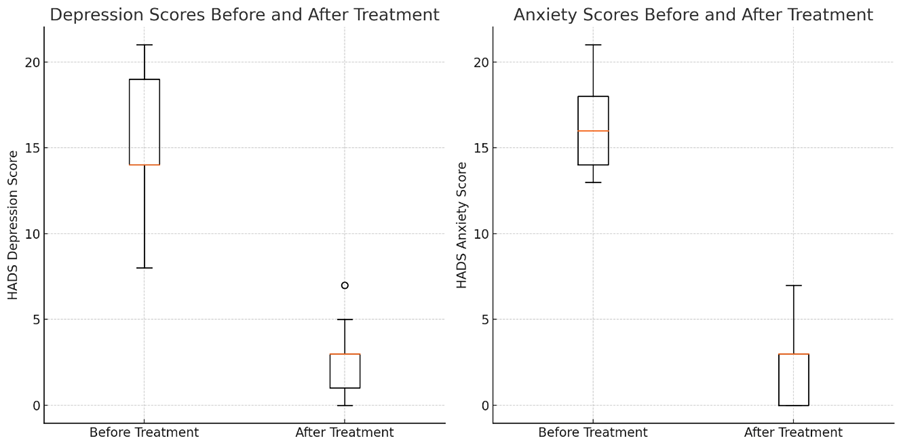
Figure 1: Showing the significant change in HADS-D and HADS-A scores before and after treatment for Ulcerative Colitis
| AgeYrs | HADSDepBefore | HADSAnxBefore | HADSDepAfter | HADSAnxAfter | |
| count | 25 | 25 | 25 | 25 | 25 |
| mean | 47 | 15.92 | 16.48 | 2.48 | 2.36 |
| std | 8.75119 | 3.499047 | 2.902872 | 2.023199 | 2.177154 |
| min | 29 | 8 | 13 | 0 | 0 |
| 25% | 40 | 14 | 14 | 1 | 0 |
| 50% | 48 | 14 | 16 | 3 | 3 |
| 75% | 53 | 19 | 18 | 3 | 3 |
| max | 61 | 21 | 21 | 7 | 7 |
Table 2: Shows the different parameters of measures in HADS-D and HADS-A before and after treatment for Ulcerative Colitis
Gender-Based Differences
- Women reported slightly higher anxiety levels at baseline.
- Post-treatment, both men and women showed improvements, but female patients exhibited more variability in symptom reduction9.
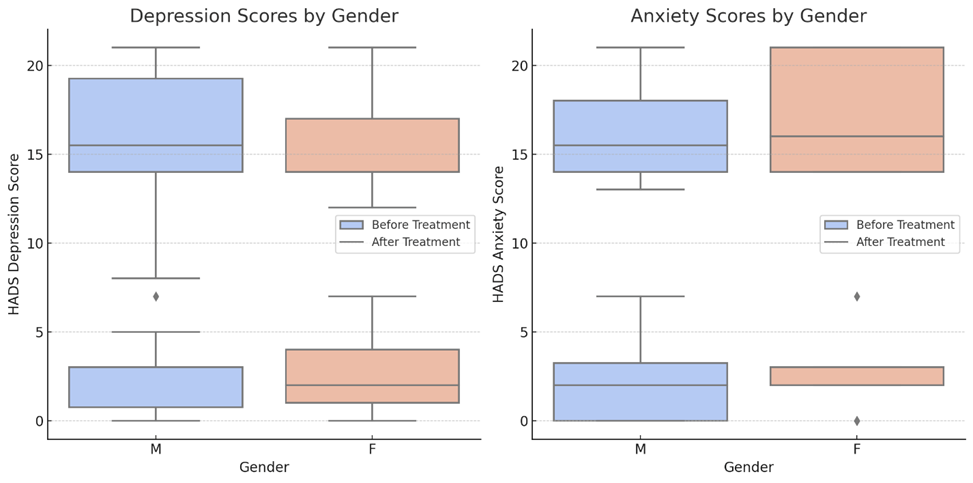
Figure 2: Showing Difference in Genders for Confidence Intervals in Males and Females before and after Treatment using HADS-D and HADS-A scores
Regression Analysis
- No significant predictors of persistent psychiatric symptoms were found10.
- Age, pre-treatment anxiety, and depression scores did not significantly correlate with post-treatment scores11.
Conclusion
This study provides new insights into the short-term psychiatric burden of UC and demonstrates that effective treatment significantly reduces anxiety and depression symptoms12. However, gender-based differences and individual variability suggest that a personalized, multidisciplinary approach is needed in UC management13.
Recommendations
- Routine mental health screenings should be incorporated into UC treatment protocols14.
- Psychiatric support should be integrated early in UC care, particularly for female patients15.
- Further research should examine long-term mental health outcomes in UC patients10.
References
- Byrne, G., Rosenfeld, G., & Leung, Y. (2017). Prevalence of anxiety and depression in patients with inflammatory bowel disease. Canadian Journal of Gastroenterology and Hepatology, 2017(3276383). https://doi.org/10.1155/2017/3276383
- Neuendorf, R., Harding, A., Stello, N., Hanes, D., & Wahbeh, H. (2016). Depression and anxiety in patients with inflammatory bowel disease: A review. Journal of Psychosomatic Research, 87, 70–80. https://doi.org/10.1016/j.jpsychores.2016.06.001
- Zhang, M., Hong, L., Zhang, T., Lin, Y., & He, Z. (2018). The relationship between inflammatory bowel disease and psychiatric disorders: A systematic review and meta-analysis. Journal of Psychosomatic Research, 111, 90–96. https://doi.org/10.1016/j.jpsychores.2018.05.008
- Zigmond, A. S., & Snaith, R. P. (1983). The Hospital Anxiety and Depression Scale. Acta Psychiatrica Scandinavica, 67(6), 361–370. https://doi.org/10.1111/j.1600-0447.1983.tb09716.x
- Wang, J. J., Fan, Y. H., Cao, W. T., Huang, R., & Yao, X. Y. (2025). Wuling powder modulating proBDNF/p75NTR/sortilin and BDNF/TrkB pathways in the treatment of ulcerative colitis complicated with depression. World Journal of Gastroenterology. https://www.wjgnet.com/1007-9327/full/v31/i8/100227.htm
- Moriya, K., Nagamatsu, S., Nishio, Y., Komeda, Y., & Suzuki, K. (2025). Efficacy of serum BDNF for the evaluation of depressive neurological symptoms in patients with refractory ulcerative colitis. Journal of Clinical Medicine, 14(3), 874. https://www.mdpi.com/2077-0383/14/3/874
- Rimmer, P., Stoica, V., Ibrahim, M., Javed, A., et al. (2025). Disability and psychological burden at IBD diagnosis and its impact on treatment outcomes in ulcerative colitis and Crohn’s disease. Journal of Crohn’s and Colitis. https://academic.oup.com/ecco-jcc/article-abstract/19/Supplement_1/i897/7967443
- Black, J., Norton, C., Sweeney, L., et al. (2025). Stress after an ulcerative colitis diagnosis: Examining factors causing or alleviating stress. Journal of Crohn’s and Colitis. https://academic.oup.com/ecco-jcc/article-abstract/19/Supplement_1/i2489/7972131
- Conley, S., Hwang, Y., Al-Saleh, S., et al. (2025). Sleep deficiency and fatigue in adults with inflammatory bowel disease: A systematic review. Western Journal of Nursing Research. https://journals.sagepub.com/doi/abs/10.1177/01939459251314941
- Jaksic, D., Vuksanovic, S., Toplicanin, A., et al. (2025). Impact of depression on health-related quality of life in ulcerative colitis patients. Journal of Crohn’s and Colitis. https://academic.oup.com/ecco-jcc/article-abstract/19/Supplement_1/i2273/7971777
- Hazan, E., Stefanova, E., Afshar, A., et al. (2025). Impairment and medication satisfaction among individuals with IBD receiving long-term biologic therapy. Journal of the Gastroenterology Society. https://pmc.ncbi.nlm.nih.gov/articles/PMC11807604/
- Bressler, B., Peyrin-Biroulet, L., Afif, W., et al. (2025). Guselkumab maintenance treatment improves health-related quality of life in patients with moderate to severe ulcerative colitis. Journal of Crohn’s and Colitis. https://academic.oup.com/ecco-jcc/article-abstract/19/Supplement_1/i2133/7972048
- Terzi, A., Artan, Y., Yıldırım, Y., et al. (2025). Fatigue in inflammatory bowel diseases: A bibliometric and content analysis. Journal of Crohn’s and Colitis. https://academic.oup.com/ecco-jcc/article-abstract/19/Supplement_1/i2512/7971966
- Salami, A. T., Akpamu, U. (2025). Activities of Sorghum bicolor diet on microbial gut-brain axis during experimental Crohn’s colitis in adult male Wistar rats. Journal of Crohn’s and Colitis. https://academic.oup.com/ecco-jcc/article-abstract/19/Supplement_1/i594/7967418
- Facanali, C., Sobrado, C. W., et al. (2025). Treatable traits approach in the management of inflammatory bowel disease: A new concept. Journal of Crohn’s and Colitis. https://academic.oup.com/ecco-jcc/article-abstract/19/Supplement_1/i2130/7972050

